Learn
What is Time to First Token (TTFT), and what is a good TTFT for AI?
The wait before an AI starts answering, and the point where people notice it.
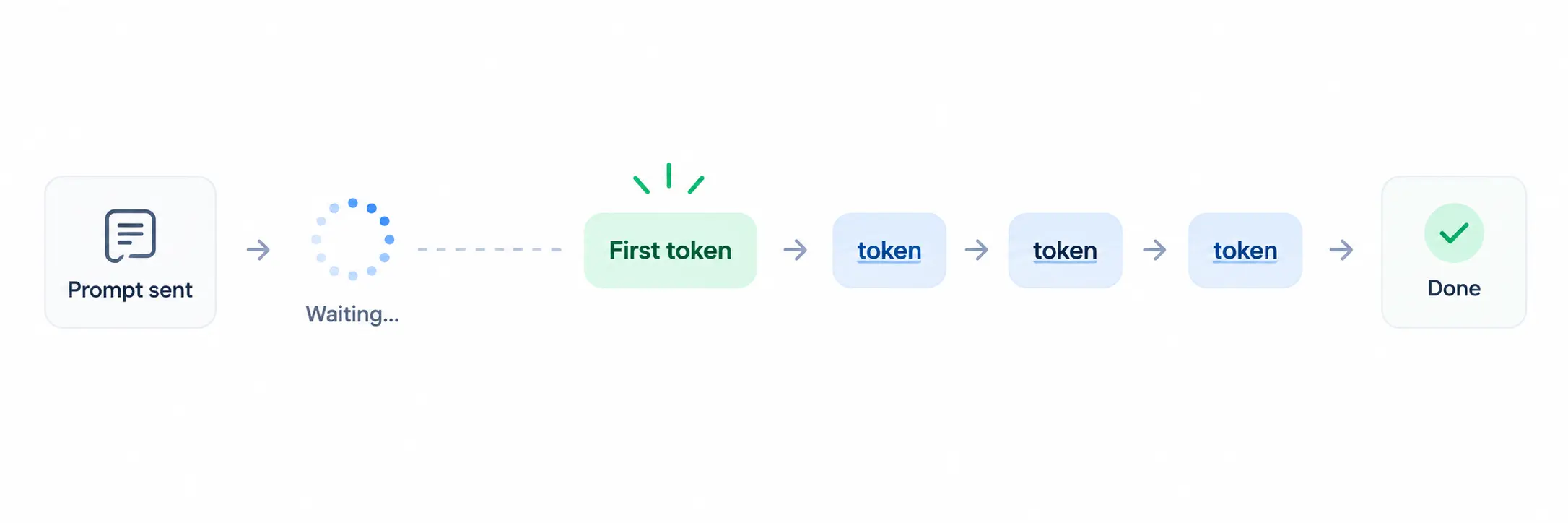
TTFT is the time between sending a prompt and seeing the first visible token of the answer. Under 500 ms feels immediate. Between 0.5 and 1.5 seconds feels responsive. Past 2 to 3 seconds people notice the wait, though reasoning models, long prompts and tool calls can take longer for good reasons.
What TTFT actually measures
The clock starts when your request leaves and stops when the first visible token arrives. Everything after that, the rest of the answer streaming in, is a different measurement. A model can start quickly and then write slowly, or the other way round.
We say first visible token on purpose. Reasoning models often emit hidden thinking before they say anything a person can read. That work is real, but it does not make a blank chat window feel any faster, so our measurements only stop the clock once there is text a user could see.
What is a good TTFT?
For a short conversational request, this is the rule of thumb we use. It is a practical guide rather than an industry standard, and different products will draw the lines in different places.
| TTFT | How it feels |
|---|---|
| Under 500 ms | Excellent. The answer seems to start at once. |
| 500 ms to 1.5 s | Fast. Most people read it as responsive. |
| 1.5 to 3 s | A noticeable wait, but usually usable. |
| Over 3 s | Slow for a one-line conversational answer. |
Context matters. A 2.5-second TTFT for a one-line chatbot reply feels slow. The same wait for a model working through a hard problem, reading a long document or calling tools before it answers can be perfectly reasonable. Judge the number against what you asked the model to do.
What real AI APIs look like
We measure the first-token time of the major AI APIs every day, from several cities, with the same short prompt and the lowest reasoning effort each model offers. This is what that looks like right now.
Typical time to first visible token across six cities and 1,260 streaming requests, 8 September to 21 September 2026. Same short prompt and the lowest reasoning effort each model offers, on paid API calls.
Updated from our daily AI API measurements →These are typical times: half of the requests in the window were faster, half were slower. Each provider's own page shows the per-city numbers and how they moved from day to day.
Why TTFT can be slow
- Prompt length. The model has to read the whole input before it produces anything. A long system prompt or a pasted document pushes the first token back.
- Model and reasoning level. Larger models and higher reasoning settings do more work before the first visible token.
- Provider load and queueing. Your request may wait in line before a GPU picks it up. When a provider is busy, most of the delay is not your network at all.
- Caching. Providers that cache a repeated prefix, such as a long system prompt, can skip much of the input processing on later requests.
- Network distance. It matters, but for hosted AI APIs it is usually a small share of the total.
In our current ChatGPT, Claude and Grok measurements, setting up the connection to the API took 14 to 28 ms, and the first visible token arrived after 787 ms to 2.7 s. For AI APIs, your provider matters more than your server location.
TTFT is not the same as tokens per second
TTFT tells you when the answer starts. Tokens per second tells you how fast it flows once it has started. The two can point in opposite directions.
A model with a fast TTFT and slow generation starts replying at once, then crawls. That is fine for a one-word answer and painful for a long one. A model with a slow TTFT and fast generation leaves a blank screen for two seconds, then the whole answer lands in a moment. That is fine for a summary and frustrating in a back-and-forth chat.
For conversational products, both matter. Google's inference metrics for GKE track TTFT and time per output token as separate numbers for exactly this reason. Our benchmarks measure TTFT only; we do not publish generation speed.
How to measure TTFT
- Stream the response. Start the timer when you send the request. Stop it when the first visible output token arrives, not when the HTTP headers do. Some providers send headers early and the first token much later.
- Do not trust one request. Run enough requests to see the typical result (p50) and the slow tail (p95). The tail is what your unluckiest users get.
- Keep everything else fixed. Same model, same prompt, same reasoning setting. Change one thing at a time.
- Measure from where your users are. If they are spread across continents, measure from several test locations. If they are all in one country, one location close to them is enough.
See how we measure AI API latency for the exact prompt, the reasoning settings and how we count a request that never shows visible text.
Common questions
- What is the difference between TTFT and TTFB?
- Time to First Byte (TTFB) is when the server sends the first byte of any HTTP response, and it applies to every website and API. Time to First Token is specific to streaming AI responses and stops at the first visible token. Some providers send headers early and the first token much later, so an AI API can have a fast TTFB and a slow TTFT. We explain TTFB in What is TTFB?.
- TTFT or tokens per second: which matters more?
- TTFT decides how long the user looks at a blank screen. Tokens per second decides how long the whole answer takes once it has started. For short chat replies TTFT dominates; for long generations, tokens per second does. Most interactive products need both to be reasonable.
- Does server location affect TTFT?
- A little. In our measurements across several cities, connection setup to the major AI APIs takes tens of milliseconds while the first token takes around a second or more, so the provider and the model matter far more than the city. A closer test location shaves off some setup time but does not change the wait for the model.
How fast are the major AI APIs right now?
We measure ChatGPT, Claude and Grok every day from test locations in Europe, North America and Asia, with the same prompt and the same reasoning setting.
Updated daily. Free, no account needed.
Get the monthly AI latency report, by test location
One email a month: how fast the major AI providers respond, measured globally.
Check your inbox for the confirmation email. Nothing is sent until you confirm. Unsubscribe any time.